
MIDI CONTROLLER / LEGACY GEARMIDI-CONTROLLER / LEGACY-GEAR
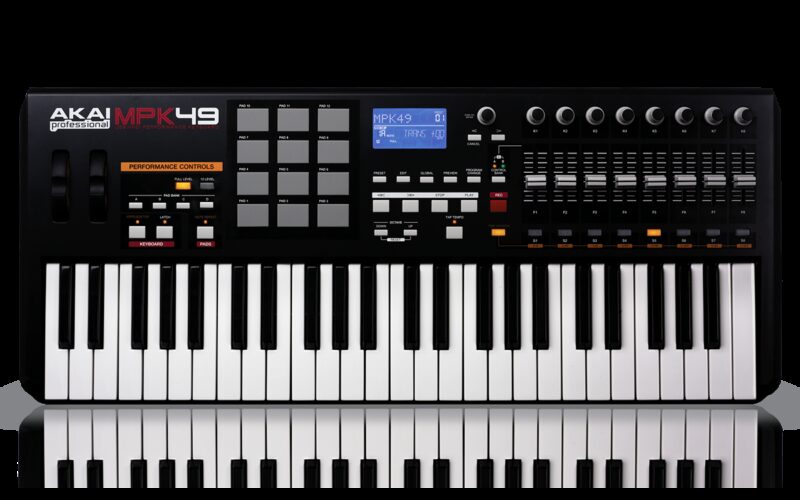
AKAI MPK49
A lucky second-hand find that became the center of my MIDI setup for years — and also taught me that more controls do not automatically mean a better workflow.Ein Glücksgriff aus den Kleinanzeigen, der über Jahre zur MIDI-Zentrale meines Studios wurde – und mir gleichzeitig gezeigt hat, dass mehr Bedienelemente nicht automatisch einen besseren Workflow bedeuten.
← Back to Studio Gear← Zurück zu Studio GearMY VERDICTMEIN FAZIT
At the time I would absolutely have bought it again. Today my workflow has changed: I want real hammer action for piano and a smaller controller for synths, bass and fast beatmaking.Damals hätte ich es sofort wieder gekauft. Heute hat sich mein Workflow verändert: Für Piano möchte ich echte Hammermechanik und für Synths, Bass und schnelles Beatmaking lieber einen kleineren Controller.
From a basic M-Audio setup to the MPK49Vom einfachen M-Audio-Setup zum MPK49
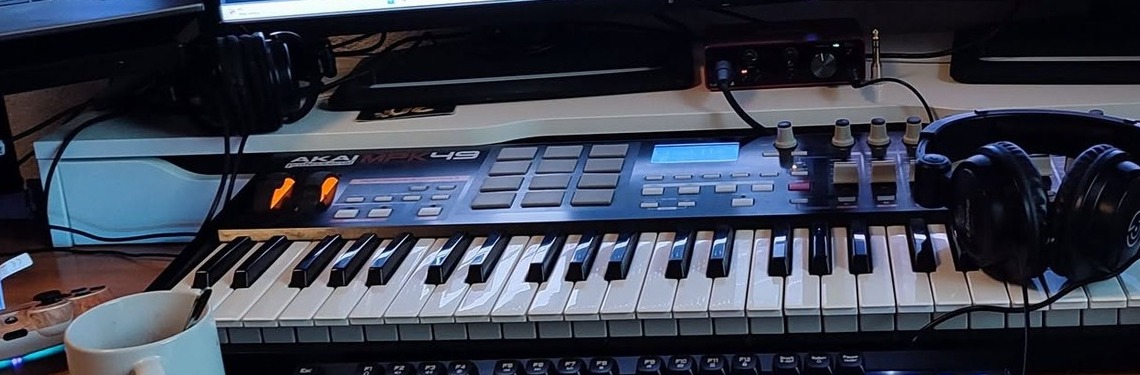
Before the AKAI I started with a very simple M-Audio keyboard that had to be connected through a MIDI-to-USB adapter. It worked, but it was clumsy. The MPK49 was a lucky second-hand find and immediately felt like a huge upgrade: direct USB, pads and a massive amount of assignable controls.Vor dem AKAI habe ich mit einem sehr einfachen M-Audio-Keyboard angefangen, das nur über einen MIDI-zu-USB-Adapter am Rechner hing. Es funktionierte, war aber umständlich. Das MPK49 war dann ein Glücksgriff aus den Kleinanzeigen und fühlte sich sofort wie ein riesiges Upgrade an: direkte USB-Verbindung, Pads und jede Menge frei belegbare Bedienelemente.
And yes — it was an AKAIUnd ja – es war ein AKAI
The name mattered to me as well. AKAI was already a brand I associated with music production and quality, so owning one felt like a step into more serious studio gear.Auch der Name spielte für mich eine Rolle. AKAI war für mich bereits eine Marke, die ich mit Musikproduktion und Qualität verbunden habe. So ein Gerät zu besitzen fühlte sich deshalb wie ein Schritt in Richtung ernsthafteres Studio-Equipment an.
Probably 70% of it was never fully usedWahrscheinlich 70 % nie wirklich ausgereizt
The MPK49 has an enormous amount of controls, pads, faders and deeper functions. Realistically, I probably never properly tested or used around 70% of what the controller can do. I could probably get much more direct control out of instruments and effects if I built my workflow around all of those functions — but I simply never needed most of them.Das MPK49 bietet enorm viele Regler, Pads, Fader und tiefere Funktionen. Realistisch habe ich wahrscheinlich rund 70 % davon nie wirklich getestet oder ausgereizt. Vermutlich könnte ich deutlich mehr direkte Kontrolle aus Instrumenten und Effekten herausholen, wenn ich meinen Workflow konsequent darauf aufbauen würde – gebraucht habe ich den Großteil davon aber schlicht nie.
The years are starting to showDie Jahre machen sich bemerkbar
Today several of the controls have developed a life of their own. Parameters can move even when I am not intentionally touching a control, which makes assigned plugin parameters difficult to trust. Driver and utility support also feels dated and can be harder to find when it is actually needed.Heute haben einige Regler leider ein Eigenleben entwickelt. Parameter können sich verändern, obwohl ich den jeweiligen Regler gar nicht bewusst bewege. Sobald so ein Regler einem Plugin-Parameter zugewiesen ist, wird zuverlässiges Arbeiten schwierig. Auch Treiber und ältere Utilities wirken inzwischen deutlich veraltet und sind bei Bedarf schwieriger aufzutreiben.
Good velocity — but still a keyboardGute Anschlagdynamik – aber eben Keyboard
For beatmaking, synths and bass the velocity-sensitive keybed was a big step up when I got it. The more piano I play, however, the clearer it becomes that it still feels like a keyboard rather than a piano. That is the main reason I eventually want real hammer action.Für Beatmaking, Synths und Bass war die anschlagdynamische Tastatur damals ein großer Schritt nach vorne. Je mehr ich aber Piano spiele, desto deutlicher merke ich, dass es sich eben weiterhin nach Keyboard und nicht nach Klavier anfühlt. Genau deshalb möchte ich langfristig echte Hammermechanik.
A real desk-fillerEin echter Tischfüller
At roughly 730 × 300 × 100 mm and around 9.6–9.8 kg, the MPK49 is surprisingly heavy and very wide for a MIDI keyboard. It needs a lot of desk space and is not something I casually move around all the time. In a fixed setup that is manageable, but it is worth planning for.Mit ungefähr 730 × 300 × 100 mm und rund 9,6–9,8 kg ist das MPK49 für ein MIDI-Keyboard überraschend schwer und vor allem sehr breit. Es braucht ordentlich Platz auf dem Tisch und ist nichts, was ich ständig nebenbei hin- und herschiebe. In einem festen Setup ist das machbar, sollte aber eingeplant werden.
Why my next setup will be split in twoWarum mein nächstes Setup zweigeteilt wird
Instead of replacing it with another all-in-one controller, I would rather use an 88-key hammer-action controller for piano and a smaller velocity-sensitive controller with pads for synths, bass, 808s and fast beatmaking. The MPK49 taught me that the functions I actually use matter more than simply having the largest possible control surface.Statt es wieder durch einen Alles-in-einem-Controller zu ersetzen, möchte ich langfristig ein 88-Tasten-Keyboard mit Hammermechanik für Piano und einen kleineren anschlagdynamischen Controller mit Pads für Synths, Bass, 808s und schnelles Beatmaking kombinieren. Das MPK49 hat mir gezeigt, dass die Funktionen, die ich wirklich nutze, wichtiger sind als möglichst viele Regler auf einer einzigen Oberfläche.
Affiliate note: This legacy product has no current Thomann affiliate link. The review is based on my own long-term use.Affiliate-Hinweis: Für dieses Legacy-Produkt gibt es keinen aktuellen Thomann-Affiliate-Link. Der Bericht basiert auf meiner eigenen langjährigen Nutzung.